
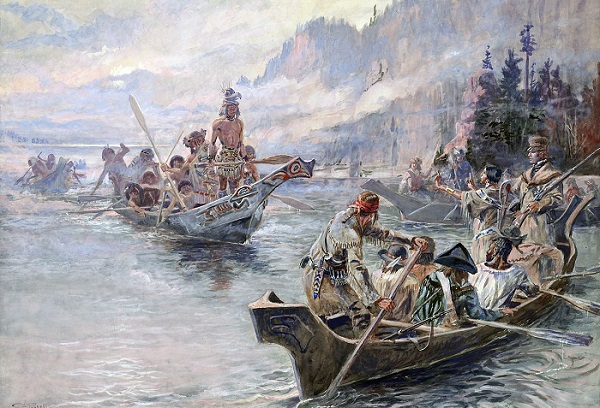
The Ken Burns documentary of the Lewis & Clark Expedition fleshes out the amazing adventures and challenges of the daring exploration of the new U.S. Louisiana Purchase and beyond.
After Thor and I had watched the Ken Burns documentary of the American Revolution, we were eager to watch more history, so we settled in with Lewis and Clark. It was a more upbeat experience (we both had found the Revolution doc somewhat depressing, with so much violence and betrayal on all sides). The documentary includes interviews with historians, paintings of key figures and events, journal and letter excerpts, some photos (from places and tribes a bit later than the actual events), maps, and a lot of really gorgeous videos of the dramatic landscapes the expedition covered. We do live among spectacular landscapes!
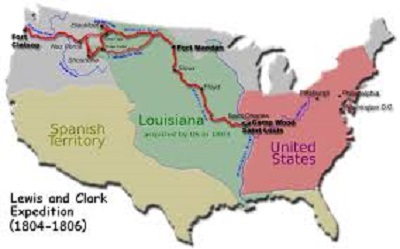
Soon after the Louisiana Purchase in 1803, which approximately doubled the land claimed by the United States, President Thomas Jefferson proposed an expedition to document and map the land, much of which was unexplored by non-natives. The main goal was to establish the U.S. claim before other European powers could do so (the Spanish already claimed large portions of the Southwest and sought to block the expedition with an armed force). A big goal was the hope of finding a water passage to the Pacific, for a trade route, as they mistakenly believed there would be a water connection to the Columbia River. (The Rocky Mountains would come as a big and dangerous surprise.) As Jefferson was a big science supporter, he also envisioned the expedition as a way to collect valuable information.
Jefferson chose Army Captain Meriwether Lewis (left) as the leader, and Lewis chose capable frontiersman William Clark as co-leader.
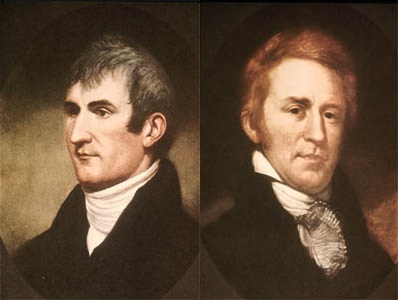
(U.S. public domain: paintings by Charles Willson Peale)
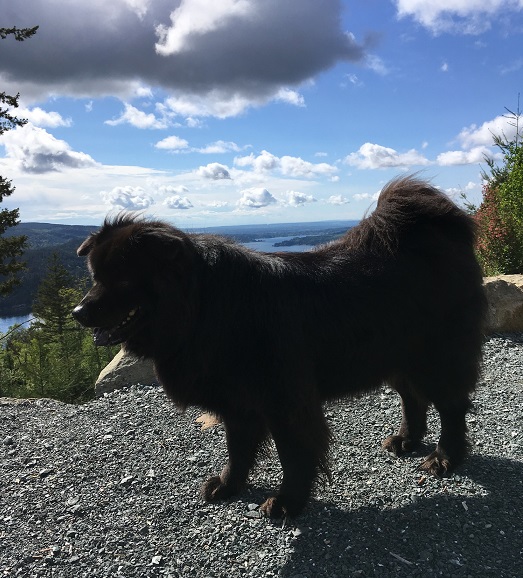
Lewis prepared with intensive study of various sciences and medicine, and ordered the building of a keelboat to start the voyage up the Missouri River. After a year of preparation, they set out from Illinois in May of 1804 with 42-45 men and a Newfoundland dog that Lewis had bought for the breed’s reputation as good swimmers that could rescue men from drowning. The dog, Seaman, also ended up assisting with hunting and bear protection along the way.
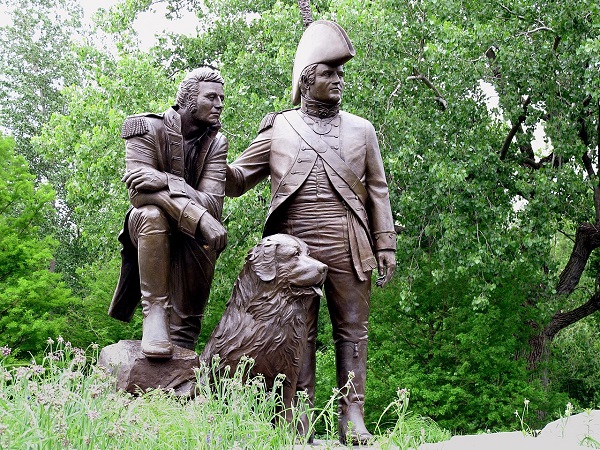
(Statue by Pat Kennedy in St. Charles, Missouri, NOAA photo library)
I can see the resemblance to our beloved Bear dog, who was part Newfoundland.
The boat was loaded with tons of supplies, including a cannon and other weaponry, a forge, and trade goods for natives they would encounter. They also had special medallions with an image of Jefferson as the new “great father” of the land to bestow on tribal chieftains.
What struck Thor and me about the expedition was the extraordinary luck they enjoyed along the way. Despite almost unbelievable trials of navigating against strong currents, portaging the boat over rough terrain, surviving brutal winter weather in the mountains, touchy contact with a few hostile tribes, running out of food, and more, they lost only one member – who died of acute appendicitis. Part of the luck was meeting the young Shoshone woman Sacagawea, who had been sold and married to a white trader. The pair joined the expedition, and Sacagawea proved invaluable as a guide to some landmarks and as an interpreter with some of the natives they would encounter. Only 16 and pregnant, she gave birth shortly after joining the expedition, and carried her infant for the rest of the perilous journey. One of the incredible coincidences of the trip was that one of the native groups was Shoshone, initially wary of helping these strangers until Sacagawea recognized the leader as her long-lost brother.
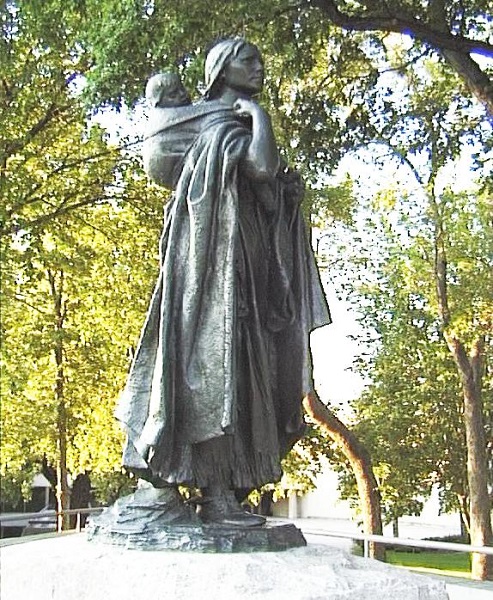
(Statue by Leonard Crunelle, photo credit Hans Andersen)
The documentary also detailed many of the survival skills possessed by the men of the team. People were tough in those days! At one point, the men had to drag the heavy keelboat and supplies over miles of portage, a landscape covered with prickly pear plants that tore through their moccasins every two days. They had to sew new footwear at night, and could barely hobble with the painful wounds from the sharp spines. On another stretch of the river, they started to encounter grizzly bears, and the initial excitement quickly wore out as they had to fight off the aggressive bears that could hardly be stopped with multiple rifle shots. With mistaken information about a “quick route” over the Rocky Mountains, they ended up traversing them as winter fell, bringing freezing and near-starvation, but somehow they made it through to a tribe that kindly took them in and fed them until they recovered. They then learned how to make canoes to continue their journey on the Columbia River to the Pacific Ocean. (Top photo of painting by Charles Marion Russell, “The Corps of Discovery Meet Chinooks on the Lower Columbia.”) There they built a fort to suffer through another very wet and cold winter.
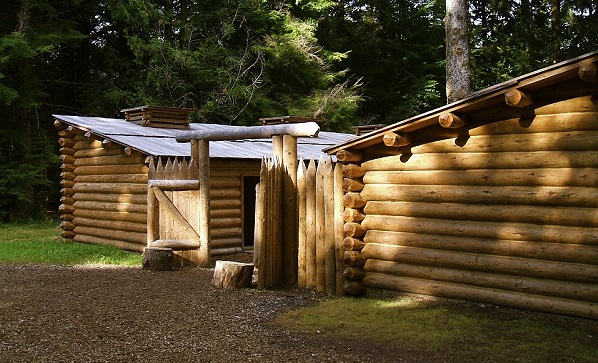
(photo by Glenn Scott Williams, Creative Commons)
By that time, with no communication, people back East were assuming that they had died. After more misadventures and encounters with some hostile natives, the group finally made it to St. Louis on September 23, 1806. Huge celebrations for the explorers ensued, as they traveled east to report on their findings.
The documentary covered many of the mostly-friendly interactions of the group with various native tribes along the way, and Lewis and Clark both apparently supported fair treatment for the tribes after the expedition. Unfortunately, many of their promises to the natives were not upheld, as the American land grabs continued to push westward. Another sad note was that although Clark took care of Sacagawea’s children after her untimely death, and promoted fair treatment of the tribes, he would not free his slave, a Black man named York, who was also an important member of the expedition. All of the other members received bonuses and double pay on their return, but York received no compensation.
The documentary also revealed the sad death of Meriwether Lewis a few years after the expedition. He had struggled for years with depression, and couldn’t seem to finish his report that he had promised Jefferson. Finally he killed himself, feeling like a failure despite all that he and the group had accomplished. He is remembered for his contributions to science and heroic leadership.
Thumb’s up for this illuminating trip through our young nation’s history!
*****
You will find The Rambling Writer’s blog posts here every Saturday. Sara’s latest novel from Book View Café is Pause, a First Place winner of the Chanticleer Somerset Award and an International Pulpwood Queens Book Club selection. “A must-read novel about friendship, love, and killer hot flashes.” (Mindy Klasky). It’s also a love letter to the stunning beauty of her native Pacific Northwest wild places. Sign up for her quarterly email newsletter at www.sarastamey.com

If you want a more hands-on experience and you are in the region… The Discovery Center in The Dalles, Oregon has a wonderful permanent exhibit on the expedition that takes up almost half the building. And Friday afternoons they do a meet and greet with birds of prey including a bald eagle. Worth the price of admission even without the birds.
Phyl, I just saw this. Sounds like a great place!