
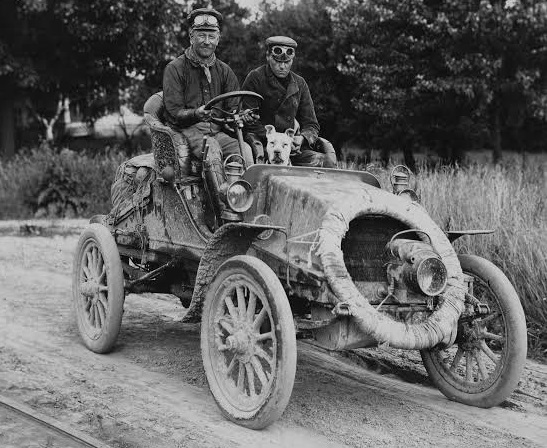
Join the fun in this Ken Burns documentary of a wild and woolly ride through history.
After Thor and I enjoyed watching the Ken Burns “Lewis and Clark” documentary, he discovered this fun gem of a Burns doc about the first U.S. cross-country trip in a “horseless carriage.” Neither of us had ever heard of Dr. Horatio Nelson Jackson, an irrepressible optimist who became a national hero in 1903. That year, he and his wife Bertha were visiting in San Francisco from their home in Vermont, when he heard members of a club disparaging the “fad” of the new invention of the automobile. He impulsively bet $50 that he could be the first to drive an auto from coast to coast within 90 days.
Four days later in May, with his wife’s permission, minimal preparation, and no maps, he and a hired mechanic, Sewall Crocker, set out with a slightly used 20-horsepower Winton car he named the “Vermont.” It was piled high with coats, rubber protective suits, sleeping bags, blankets, canteens, a water bag, an axe, a shovel, a telescope, tools, spare parts, a block and tackle, cans for extra gasoline and oil, a Kodak camera, a rifle, a shotgun, and pistols.
They planned to go north and then east through Idaho to avoid the highest mountain passes, but in those days there were no roads made for autos, just dirt tracks for horses and wagons. Their first breakdown came at 15 miles, with a flat tire, and they had only one spare. The trip, involving many detours, misdirections from locals, and loss of gear that bounced off the back, was a series of mini disasters, but somehow Jackson and Crocker soldiered on, sometimes finding blacksmiths to improvise repairs, and sometimes waiting in towns for a train to deliver necessary parts. At every stop, Jackson would send chipper message home to his wife Bertha, whom he called “Swipes,” declaring that the worst was behind them, and they would be making good time soon. The documentary describes him as a man who would call a near-empty glass “half full.” (Tom Hanks provided just the right voice for Horatio’s letters in the documentary, capturing that energy.)
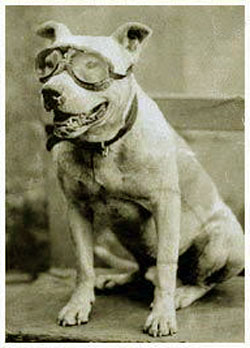
Around Wyoming, Jackson paid $15 for a bulldog he named Bud, who quickly learned to love riding along with his own goggles to protect his eyes from the dust. When not dusty, the tracks were often nothing but mud that mired them so they needed to use the block and tackle or flag down passing horsemen or wagons to pull them out. They often had to cross streams, and these also involved the block and tackle. Some of the images of high passes they traversed over boulders and beside sheer drops are unbelievable. What an adventure!
The documentary echoes the can-do spirit of the Lewis and Clark expedition, as much of the western part of Jackson’s trip had no maps. They sometimes followed old wagon-train routes, or sought out railroad tracks in order to cross rivers on their bridges.
While they were enroute, Jackson and Crocker learned that two rival teams, financed and backed by different automobile manufacturers, had set out from the west coast to beat them to New York. So the race was on. Halfway through, past the worst of the “roads,” the Winton company offered to support Jackson with mechanics and parts to wait at stops along the rest of the route. Jackson refused the support, stating that he figured they were doing just fine on their own. And his buoyant faith paid off when they arrived in New York 63 days, 12 hours, and 30 minutes after leaving San Francisco, beating the other two teams. Jackson became a hero, with people flocking in every town he passed just to witness the horseless carriage for the first time and maybe get a short ride. This trip symbolized a turning point in the history of the U.S. (and world), as the shift toward gasoline-powered transportation was now inevitable, for better or worse.
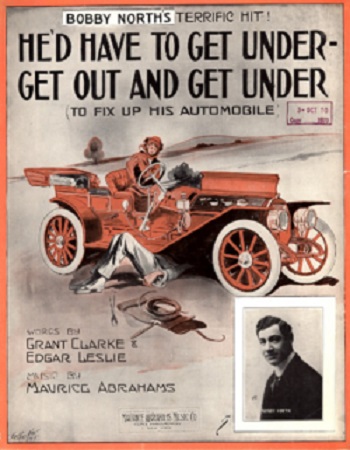
The documentary is highly entertaining and funny as it chronicles the misadventures and triumphs, but also highlights beautiful scenery, mostly in the West, of the wild lands covered. Archival photos and film clips capture the era beautifully, from the rugged horse tracks to the crowds of townfolk across the country. A hilarious segment shares a bit of a 1920 silent film following the plot of a popular song ,“He’d Have to Get Under,” that comically described an early owner of an auto attempting to woo a young woman with a ride, only to break down constantly and have to “get under” to make repairs. Maybe it was the first music video!
There are also brief commentaries by historians, among them William Least-Heat Moon, the author of “Blue Highways,” who extolls the romantic call of the open road in the Americas.
After enjoying the “ride,” I looked up a bit more about Horatio Nelson Jackson and learned that at age 41, he petitioned his friend President Theodore Roosevelt to be allowed despite his age to serve during World War I in Europe as a Medical Corps captain. He served heroically on the front lines and was apparently an inspiration to the men, was wounded, and received medals from the U.S. and French. He went on to become a founding “Daddy” of the American Legion, and lived to a happy old age. What a can-do spirit!
(photos credit: Wikimedia Commons)
*****
You will find The Rambling Writer’s blog posts here every Saturday. Sara’s latest novel from Book View Café is Pause, a First Place winner of the Chanticleer Somerset Award and an International Pulpwood Queens Book Club selection. “A must-read novel about friendship, love, and killer hot flashes.” (Mindy Klasky). It’s also a love letter to the stunning beauty of her native Pacific Northwest wild places. Sign up for her quarterly email newsletter at www.sarastamey.com