
In which Thor explains his educational skull collection and his rot box
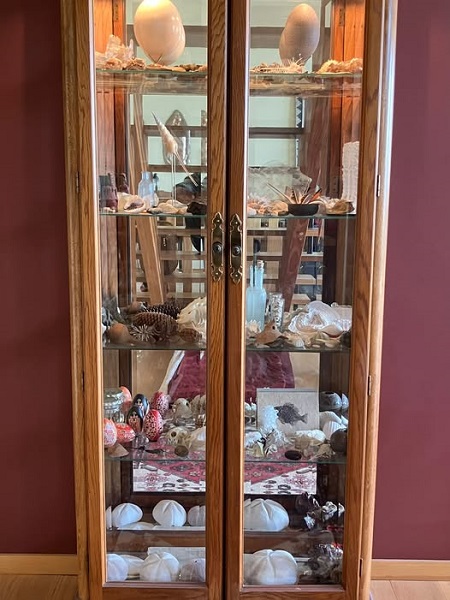
Like typical philosopher/scientists of the 19th century, Thor and I have a curio cabinet full of specimens, travel mementos, and stories.
Take it away, Thor:
We have several skulls in our curio cabinet and bigger skulls strewn about the house, from local and exotic mammals and birds. Back in the 90’s I got into collecting skulls. Skulls are cool in their own right, but they are also one of the most informative bones in a skeleton (informing about diet and intelligence). and I was teaching a dinosaur class at the time, so they were a handy teaching tool. Where do you get skulls? You can buy them, but they can be expensive. and besides, what’s the fun in that?
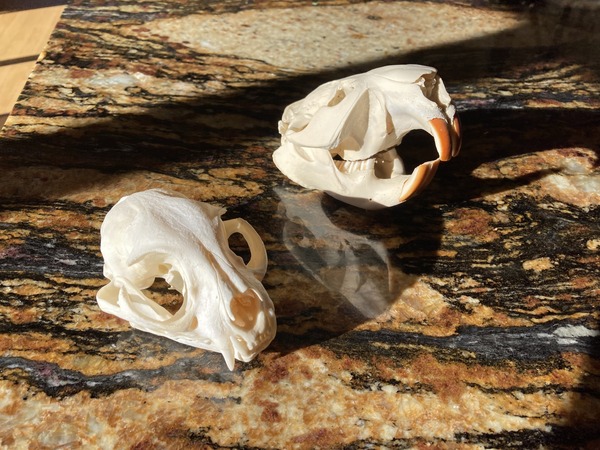
Top photo: Bobcat skull, left, and beaver skull, right.
So I started picking up roadkill. Now believe it or not, you need a license to pick up dead animals. I got a salvage permit to pick up bodies for educational purposes. The only trouble with roadkill is that they have been hit by a car at high speed, and very often the skull is damaged. I also developed a relationship with an institute in Abbottsford, Canada that autopsies dead animals from local zoos. I got to know the director, and I would call every few weeks to see what he had lying around.
But once you have a dead animal, how do you clean it? When I started this hobby, there wasn’t an internet to consult on cleaning animal heads. Taxidermists and specialists who study skeletons use colonies of dermestid beetles to clean their bones. They have a large box full of these carnivorous beetles, and they “feed” them from time to time with a fresh body. Throw in a bloody corpse, and a few weeks later…. Voila! A clean skeleton. Of course you need a special room for the box (there is an odor), and I was living out in the county and without a place for it. So I kind of winged it. I started off boiling the heads. I figured if I boiled it long enough for the meat to fall off, I could clean a skull pretty quickly. The first time I tried this was with the heads from a wolf and an antelope.
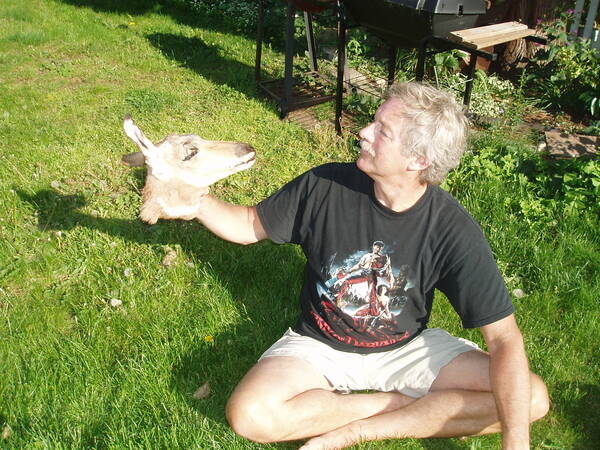
Tete a tete with an antelope
I boiled them in a big pot in the kitchen for a couple hours. These heads were complete, i.e. they still had hide, fur, tongue, eyeballs, the whole works. And when you boil an intact head… it stinks. So the kitchen smelled pretty funky. I took the cooked heads to the sink and started to work on removing the flesh. My daughter Laura was 4 years old at the time, and she was always curious about whatever I did. She climbed up on the counter and sat cross-legged next to the sink to watch. When you boil a whole head, the hide of the face contracts and gets kind of rubbery, so you can simply pull the skin off the skull in one large piece, leaving you with a something like a rubber Halloween mask. With my daughter watching intently, I figured this was a good time for a little show, so I put the wolf mask on my right hand and the antelope on my left and let them have a little dialog:
Wolf: “Grrrrhhh, I’m gonna EAT YOU!”
Antelope: “Oh no! Please don’t eat me!”
Etcetera. I don’t recall the entire conversation, but needless to say it was very educational, and Laura seemed to enjoy it, albeit a bit queasily.
The flesh came off the bones without too much trouble, but the brain was a problem. There it was, cooked and crumbly, but housed in the bony skull, and the only exit was from the foramen magnum, the large hole at the base of the skull where the spinal cord exits. I had to stick a long screwdriver up into the skull and twist it around to scramble the brain and then try to shake it out of the skull using plenty of water. It was a mess, and the kitchen stank.
Needless to say, Penny, my wife at the time, was not on board with this. But the real deal-breaker occurred shortly after. On one of my hikes, I found a carcass of a skunk, just the rear half. It lacked a skull, but I had no skunk parts in my collection, so naturally I took it home. It was a little dry, so I put it in the laundry room sink with some water to moisten it. Don’t want it to mummify. Well, I forgot about it. A few days later Penny approaches me and says, “Thor….” in that tone that says I need to pay attention. “What is in the laundry room sink?” I was confused at first, but then I remembered. “Oh, that’s a skunk butt!” Which meant now it was time for:
Plan B.
To be continued next week!
Note from Sara: Thor and I were seemingly destined to join forces, albeit not until midlife. We both love rocks and skulls. The beaver skull shown above was actually from a dead beaver I had found down by the creek at our former home, but before Thor and I had met. I took the head and put it a bucket of water with bleach, and before long had a lovely, clean skull with very long teeth that I could pull forward from the sockets to show the way the teeth keep growing as the beaver gnaws on trees.
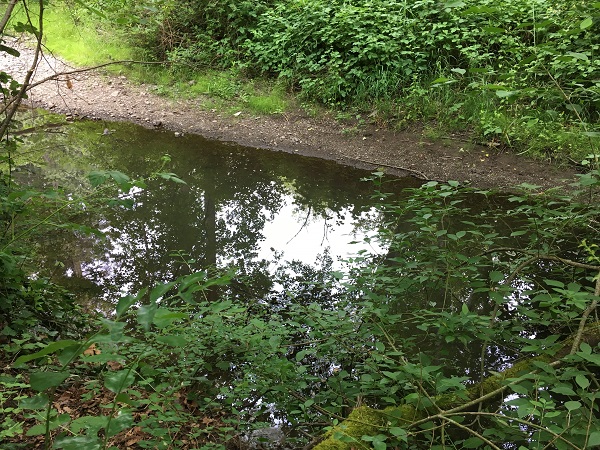
Squalicum Creek at our former home.
*****
You will find The Rambling Writer’s blog posts here every Saturday. Sara’s latest novel from Book View Café is Pause, a First Place winner of the Chanticleer Somerset Award and an International Pulpwood Queens Book Club selection. “A must-read novel about friendship, love, and killer hot flashes.” (Mindy Klasky). It’s also a love letter to the stunning beauty of her native Pacific Northwest wild places. Sign up for her quarterly email newsletter at www.sarastamey.com